
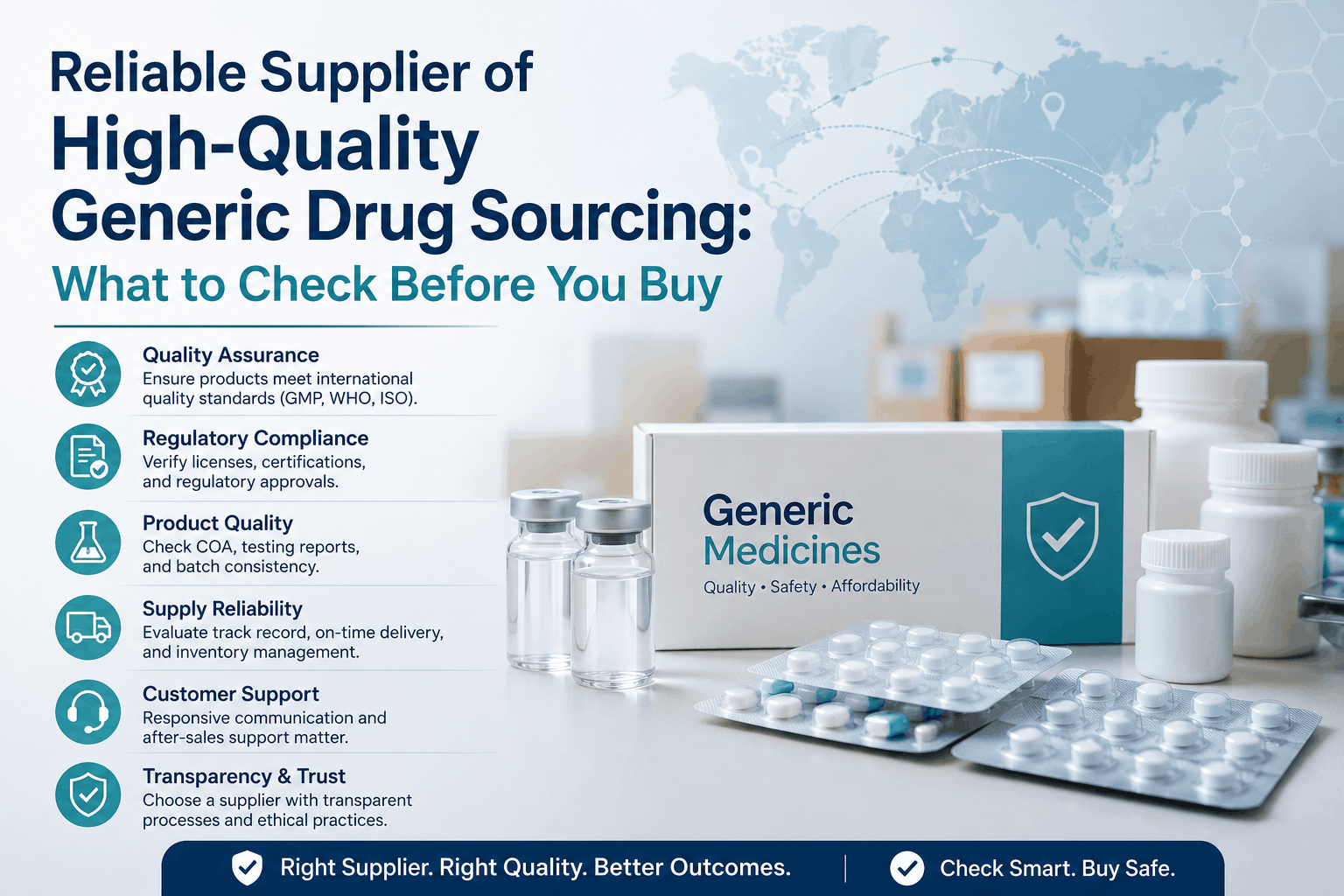
Finding a Supplier and Choosing the Right One Are Two Different Things
Most procurement teams assume the hard part of generic drug sourcing is finding a supplier. In practice, that is rarely where the difficulty lies. There are plenty of options. The harder part is knowing which one will hold up once the process begins.
Two suppliers may offer the same molecule, the same strength, and similar pricing. But the experience of working with them can be completely different. One keeps things steady and predictable. The other introduces small uncertainties — unclear documentation, shifting timelines, gaps that only appear mid-way through the process.
That difference rarely comes from what is being sold. It comes from how the supply is structured behind the scenes.
For hospitals, importers, and procurement teams sourcing oncology medicines, rare disease treatments, or critical care drugs across EU markets, the real question is not just where to buy. It is how to find a supplier who delivers consistently, without creating friction at estep.
Why Your Choice of Supplier Affects More Than Just Price
Generic medicines are often bought on cost. But from a sourcing perspective, they come with sensitivities that go beyond the unit price.
A supplier’s process influences how reliably medicines cross borders, whether documentation aligns with regulatory expectations, and how much correction and rework the process requires. These are not abstract concerns. They directly affect timelines, operational effort, and in many cases, whether a patient receives treatment on time.
This is true across categories — from oncology medicine supply in Europe, to EU compassionate use medicine sourcing, to managed access programs, to HIV medicine alternative supplier arrangements in Europe. The stakes differ by category, but the underlying sourcing challenge is the same.
What Actually Makes a Generic Drug Supplier Reliable
On paper, most suppliers tick the same boxes. They mention compliance, quality, and global reach. The real difference shows up in how these things work in practice.
Regulatory Alignment Across EU Markets
EU pharmaceutical regulations are structured, but they are not uniform across emember state. Documentation formats, validation steps, and country-level declarations vary — and a reliable GMP approved medicine supplier in Europe builds their process around this, rather than treating it as an exception.
You can usually tell early in the conversation. Instead of a quick confirmation, a well-structured supplier asks where the product is going, which regulatory pathway applies, and what documentation is already in place. It may feel like an extra step. In practice, it prevents delays later.
Sourcing Clarity and Traceability
Knowing a product is available is not the same as knowing where it comes from or how it has been handled. This matters across all categories — from oncology medicine alternative suppliers in Europe, to HIV medicine sourcing, to orphan drug supply in the EU market.
A dependable supplier does not keep sourcing vague. They may not share eoperational detail, but they can explain the logic clearly and confidently. In cross-border supply within Europe, traceability is a regulatory requirement, not a preference.
Handling and Logistics With Structure
Inconsistent storage or transport practices affect product integrity, compliance acceptance, and delitimelines. This is especially critical for critical care drug supply in the EU, where delays carry direct clinical consequences.
Reliable suppliers approach logistics with defined protocols and planned transit routes — not improvisation. The goal is a predictable process, not a perfect one.
Process Clarity From Request to Delivery
A simple test: ask a supplier to walk you through exactly what happens after a request is raised. A well-structured supplier can explain each step — where documentation is reviewed, how sourcing is confirmed, and what influences timelines. This reduces the need to chase updates and makes the sourcing process easier to manage on your side, especially for recurring requirements like orphan drug supply or managed access programs.
Pricing: What the Quote Does Not Tell You
Cost is a natural first point of comparison in the generic drug market. But a lower quote rarely reflects the full picture.
It may not account for gaps in documentation handling, the likelihood of delays or rework, or the level of coordination your team will need to provide throughout. This does not mean higher pricing is better. It means pricing should be evaluated alongside the structure behind the supply.
More useful questions to ask:
- What does the price include?
- How stable is this supply at that price point?
- What level of coordination will be needed from our side?
For long-term programmes — rare disease medicine supply in Europe, EU compassionate use medicine sourcing, or a manage access program for specific patient groups — these questions matter more than the headline figure.
Early Signs That a Supplier May Not Be the Right Fit
Some problems become visible early, before a request is fully processed.
Watch for vague responses when you ask specific questions, overly confident timelines without understanding the full requirement, repeated need for clarification on basic documentation, and lack of clarity around where the product is sourced from.
Individually, these may seem minor. Together, they indicate a process that will need more management from your side than expected — which becomes a real operational problem when you are managing time-sensitive EU compassionate use medicine sourcing or critical care drug supply.
What Happens After You Shortlist a Supplier
Once you have identified a few options, most obvious checks are done. They have the product. They understand the requirement. They have shared pricing. Everything looks aligned.
What separates one supplier from another is how things behave once the process starts.
Early Conversations Are the Easy Part
Initial discussions are usually smooth. Suppliers respond quickly and confirm availability. That is not where the real evaluation happens.
What matters more is how they handle situations where things are not perfectly aligned — which is almost always the case in real sourcing. Ask practical questions:
- How do you handle documentation that needs revision mid-process?
- What happens if supply is confirmed but dispatch is delayed?
- How do you manage regulatory differences across EU member states?
A supplier with real experience answers these calmly and clearly. One without it keeps responses general.
Three Assumptions That Create Sourcing Problems
If it worked once, it will work the same way again. Regulatory interpretation changes. Documentation expectations shift. Supply availability varies. Experienced suppliers revalidate key steps even when the request looks familiar.
Faster responses mean a faster process. A quick reply that needs follow-up clarification often adds more time overall. More reliable suppliers respond with more context, clearer next steps, and fewer gaps that need addressing later.
The lowest price is the best value. In generic drug sourcing, a lower cost at the start can mean higher operational effort throughout. For complex categories like orphan drug supply in the EU market, managed access programs, or oncology medicine alternative suppliers Europe procurement teams rely on, process reliability is part of the cost equation.
Common Mistakes That Slow Down Generic Drug Sourcing
Starting with incomplete information. Without full clarity upfront, requests require multiple rounds of follow-up — product specifications, documentation restructuring, regulatory alignment. Each round adds delay.
Rushing the first step. When the initial stage is compressed, documentation errors are more likely, requirements may be misunderstood, and corrections become necessary later.
Working across too many suppliers without consistency. Multiple suppliers means different documentation standards, communication styles, and process expectations. When timelines are tight, that inconsistency becomes a coordination problem.
How Reliable Suppliers Stay Consistent Over Time
Consistency is not just about delivering once. It is about building a process that becomes easier to repeat.
Reliable suppliers follow a defined approach — consistent documentation handling, a clear sequence from sourcing to delivery, and defined checkpoints. Over time, they develop familiarity with how a client operates: preferred formats, typical product requirements, internal approval processes. This reduces repeated clarification and speeds up execution without rushing it.
Proactive communication is another marker. Instead of waiting for problems to surface, experienced suppliers flag them early — a documentation revision that may be needed, a potential timeline shift, missing information before it becomes urgent. This reduces uncertainty and allows better planning on both sides.
Where IKRIS Pharma Network Fits Into This
As the generic drug supply chain becomes more interconnected, what buyers expect from suppliers is shifting. Access to medicines is no longer enough on its own. What matters increasingly is whether that access stays consistent and manageable across eorder.
IKRIS Pharma Network operates as a GMP approved medicine supplier serving hospitals, importers, procurement teams, and distributors across Europe and globally. The focus covers oncology medicine supply in Europe, rare disease medicine sourcing, HIV medicine alternative suppliers Europe increasingly rely on, orphan drug supplier services for the EU market, critical care drug sourcing, and EU compassionate use medicine programmes.
The approach is consistent across all categories: align documentation early, maintain sourcing clarity, and structure the process in a way that reduces back-and-forth. For organisations managing recurring or cross-border requirements, this consistency is what makes long-term supply relationships work.
Frequently Asked Questions
How can I verify if a generic drug supplier is reliable?
Ask about process transparency, not just product availability. A dependable supplier can explain sourcing, documentation handling, and timelines clearly — without relying on vague assurances.
Is regulatory compliance enough when choosing a supplier?
Compliance is necessary but not sufficient. The ability to apply regulatory requirements correctly across different EU markets is what determines whether supply moves smoothly.
Why do delays happen even when everything looks aligned initially?
Most delays come from small gaps — documentation adjustments, regulatory interpretation differences, or supply timing issues. These are not always visible at the start but become clear once the process is underway.
Should pricing be the primary factor in selecting a supplier?
Pricing should be evaluated alongside process reliability, sourcing clarity, and supply consistency. Focusing only on cost can overlook factors that significantly affect the overall sourcing experience — particularly for oncology medicine or rare disease medicine supply in Europe.
What makes EU-based suppliers more reliable for global sourcing?
EU suppliers typically operate within structured regulatory frameworks and have experience managing cross-border complexity — making them better equipped to handle requirements that span multiple markets consistently.
IKRIS Pharma Network is a GMP-aligned pharmaceutical supplier serving hospitals, importers, and procurement teams across Europe and globally. For sourcing enquiries, contact our team.