
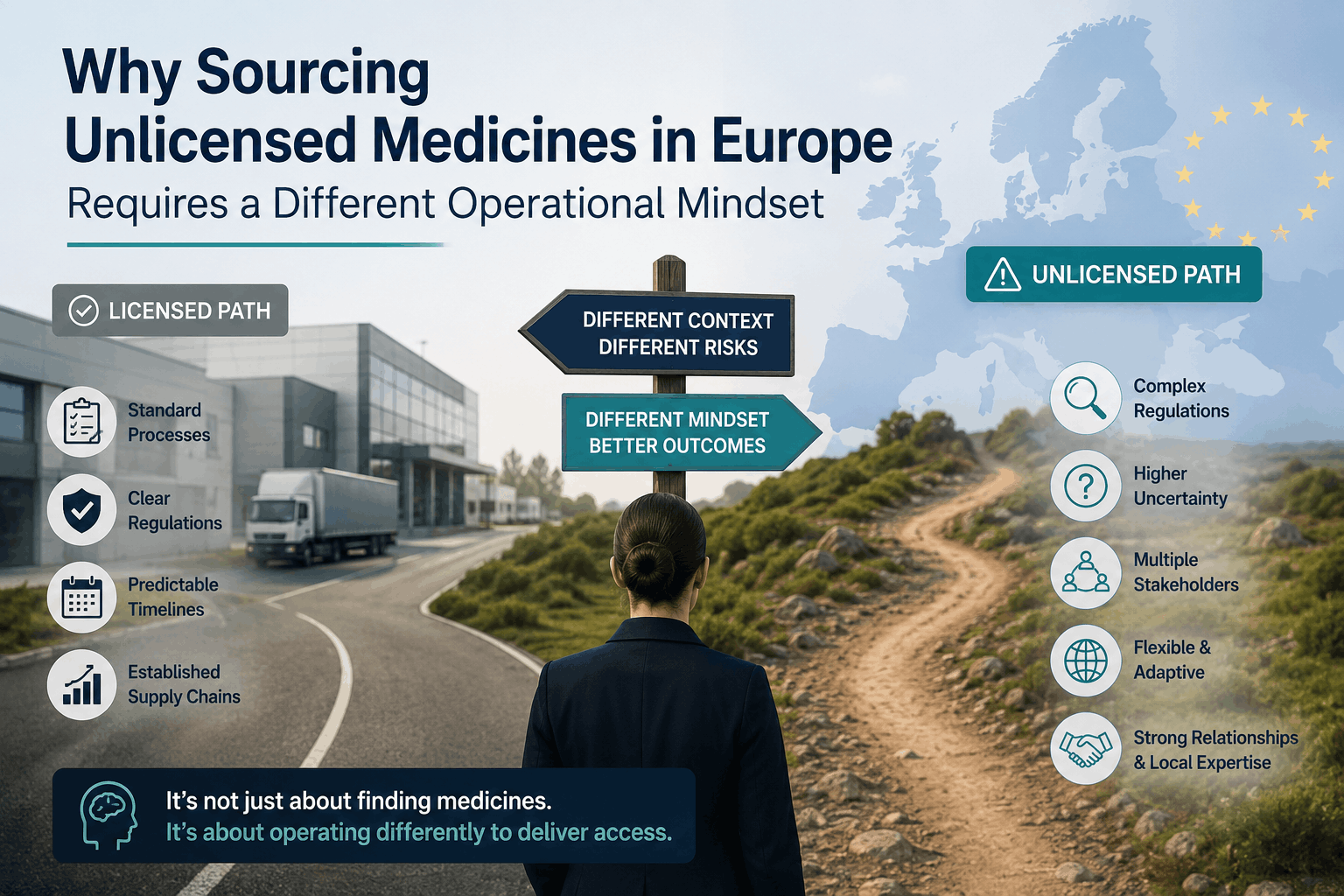
Sourcing unlicensed medicines in Europe is not simply an extension of pharmaceutical distribution. It operates on an entirely different rhythm — one that demands a different kind of readiness, precision, and coordination at every stage.
In conventional wholesale, operations are built around forecasting demand, maintaining stock, and ensuring timely replenishment. The process is continuous and relatively predictable.
With unlicensed medicines, none of this applies in the same way. There is no stable demand curve, no routine supply cycle. Each requirement appears independently — often without prior notice — and must be handled with immediate, structured coordination.
This changes everything about how businesses need to think and operate.
The Starting Point: Clinical Need, Not Commercial Demand
Unlike standard pharmaceutical supply, where market patterns drive demand, unlicensed medicine sourcing always begins with a clinical trigger.
A treating physician identifies that available treatments are not effective, no approved alternative exists, and a specific unlicensed medicine may offer potential benefit. At this point, the process is still entirely within the clinical domain.
The physician must medically justify the need, identify the appropriate treatment option, and initiate the request under the applicable regulatory pathway. Understanding the difference between named patient programs vs compassionate use is essential at this stage, as the pathway chosen directly shapes everything that follows.
This stage is critical — everything that follows depends on how clearly and completely this need is defined and documented. Any ambiguity here can slow down the entire process before sourcing even begins.
How Requests Move from Hospitals into the Supply Chain
Once the clinical need is established, the request begins moving outward — from the healthcare setting into the regulatory and supply chain environment.
It typically flows through the hospital or healthcare institution, internal approval mechanisms depending on the country and institution, and then national regulatory frameworks or designated authorities.
At each stage, documentation is reviewed not just for completeness, but for validity and alignment with regulations. Only after this process is cleared does sourcing actually begin — unlike traditional procurement, where sourcing may start early.
This sequencing ensures medicines are not sourced without proper authorisation, supply aligns with legitimate medical need, and traceability begins from the earliest stage.
Verification Before Sourcing Begins
Before a supplier is even contacted, there is an important layer of verification that often goes unnoticed.
This includes confirming whether the medicine is truly unavailable within the EU, whether any approved alternatives exist, and whether the product requested precisely matches the clinical requirement.
In some cases, requests are delayed or reconsidered because an alternative becomes available, the requested product does not meet regulatory expectations, or additional clinical clarification is required.
For suppliers, this means demand is filtered not just by clinical need — but by regulatory and medical validation before it ever reaches them.
What Actually Happens During Supplier Engagement
Once a request reaches the sourcing stage, the interaction with suppliers looks very different from routine procurement.
Suppliers are not simply asked whether they have a product in stock. They are evaluated on their ability to source from verified manufacturers, their experience with unlicensed medicine requests, their understanding of documentation requirements, and their capacity to manage time-sensitive shipments.
Details exchanged at this stage include product specifications, batch information, storage and transport conditions, and the documentation that will accompany the product.
Unlike standard orders where some flexibility exists, the margin for error here is extremely narrow. A mismatch in product details or documentation can lead to delays at customs, rejection by authorities, or an inability to use the medicine clinically.
The Hidden Complexity: Documentation Alignment Across Multiple Points
One of the most demanding aspects of this process is not the product itself — it is ensuring that documentation aligns consistently across all stakeholders.
Clinical justification documents, regulatory approvals, supplier certifications, transport documentation, and import-related paperwork all originate from different points in the system. Yet they must all refer to the same product, reflect the same patient or program, and remain consistent in every detail.
Even small discrepancies — variations in product naming or batch references — can create friction during customs clearance or at final delivery.
This is why experienced operators cross-verify documentation before shipment begins, rather than attempting to correct issues after the fact. Full pharma compliance across all documentation points is what separates smooth operations from costly delays.
Logistics: Precision Over Speed
Once sourcing is confirmed, logistics becomes the next critical layer.
Unlike standard pharmaceutical shipments, unlicensed medicine logistics often require case-specific planning based on the product’s temperature sensitivity, urgency of delivery, cross-border regulatory requirements, and availability of compliant logistics providers.
What makes this stage particularly challenging is the balance between speed — due to patient need — and compliance — due to regulatory expectations. A shipment that arrives quickly but without proper documentation or temperature control can still be unusable.
Why Coordination Defines Success
If there is one factor that consistently determines how smoothly this process works, it is coordination.
At any given time, multiple stakeholders are involved — physicians, hospitals, regulatory bodies, suppliers, and logistics providers. Each operates within their own framework, but their actions must align for the process to move forward without disruption.
Breakdowns typically happen not because one party fails entirely, but because information is delayed, documentation is inconsistent, or expectations are not clearly communicated.
This is why experienced operators invest heavily in clear communication channels, pre-defined workflows, and real-time updates throughout the process.
The Seven-Step Execution Process
Once the need is identified and the pathway is clear, the process shifts from theory into execution. In practice, these steps overlap, loop back, and depend heavily on one another.
Step 1 — Formalising the Request The treating physician’s clinical need must be converted into a structured regulatory application — establishing why approved medicines are insufficient, what benefit the unlicensed product offers, and whether the request falls under an individual or program-based pathway. A clear understanding of importing unlicensed medicines for patient care helps institutions prepare accurate, complete applications from the outset.
Step 2 — Regulatory Review Once the request moves beyond the healthcare institution, it enters the regulatory layer. This is where the EU system becomes country-specific — approval processes, documentation formats, and timelines vary significantly across member states. Experience in specific markets reduces delays considerably.
Step 3 — Source Validation Unlicensed medicines cannot be sourced from just any available supplier. The source must be verified as legitimate, able to provide full product traceability, compliant with quality standards, and capable of supporting documentation requirements. Working with a trusted unlicensed medicine supplier in Europe at this stage significantly reduces the risk of documentation gaps or compliance failures later in the process.
Step 4 — Documentation Alignment Before any product is physically moved, documentation must be aligned across all parties — clinical justification, regulatory approvals, supplier documents, and import-related paperwork. Experienced operators treat this as a continuous process, not a final step.
Step 5 — Procurement and Controlled Dispatch Only after documentation is aligned does procurement take place. The supplier prepares the product under controlled conditions — case-specific, time-sensitive, and closely monitored — with correct packaging, tracking mechanisms, and defined delivery timelines.
Step 6 — Cross-Border Movement and Import Handling If the medicine is sourced from outside the receiving country or outside the EU, this stage becomes particularly sensitive. Customs authorities scrutinise whether the product matches the approved request, whether the source is legitimate, and whether all required approvals are in place. Partnering with an experienced EU hospital tender medicine supplier ensures the shipment arrives with everything needed for smooth import clearance. Accuracy earlier in the process becomes critical here.
Step 7 — Final Delivery and Clinical Handover Once the shipment clears all checkpoints, it moves to the hospital or designated healthcare provider. The receiving entity verifies the product, confirms documentation is intact, and ensures storage conditions are maintained before the medicine enters clinical use.
Where Delays and Bottlenecks Typically Occur
Even with a structured process, delays happen. Common pressure points include incomplete clinical documentation at the initial stage, regulatory clarifications requiring back-and-forth communication, difficulty identifying a compliant supplier, documentation misalignment across stakeholders, and customs-related checks during import.
These delays are rarely caused by a single failure. They are usually the result of small gaps accumulating across multiple stages — which is why experienced operators focus on how smoothly each step connects with the next, not just on individual steps in isolation.
Building for Scale: From Case Handling to System-Based Operations
Over time, certain therapies — particularly in oncology, rare diseases, and advanced biologics — are required not just once but repeatedly, across multiple patients and extended treatment cycles.
This is where operations begin to shift. What started as isolated case handling gradually becomes a repeatable, though still highly controlled, process. Organisations that operate in this space for longer move from reactive handling to building dedicated workflows, internal coordination teams, and pre-aligned supplier networks.
The key distinction: unlicensed medicine sourcing never becomes routine in the way standard distribution does. Each request still requires medical justification, documentation alignment, and regulatory awareness. But the frequency of requests creates a need for more structured internal systems. Reliable named patient medicine service providers become essential partners at this stage, helping organisations manage recurring access requests with consistency and compliance.
Managing Risk Across the Process
Risk in this space exists simultaneously at multiple levels.
Product integrity risk requires supplier verification, batch-level traceability, and controlled logistics — especially for temperature-sensitive medicines where even a small lapse in handling conditions can affect usability.
Regulatory alignment risk stems from the fact that EU member states apply a shared framework differently in practice. Documentation formats, approval processes, and authority involvement vary by country. Managing this requires not just knowledge of EU regulations, but familiarity with country-specific execution.
Operational coordination risk arises because multiple stakeholders are involved at every stage. Delayed communication, incomplete information transfer, or misaligned timelines can create a chain reaction — a small documentation delay can hold a supplier, delay a shipment, and ultimately affect patient care.
Handling Urgency Without Breaking the System
Patients requiring unlicensed medicines are often in situations where time is critical, treatment options are limited, and delays carry serious consequences. This creates pressure to act quickly.
However, speed without structure introduces risk. The key is not to move faster by cutting corners, but to move faster by being prepared in advance — through pre-qualified supplier networks, ready documentation templates, and established rapid-response protocols.
When systems are built this way, urgency can be managed without compromising compliance. This is precisely where working with an experienced eu compassionate use medicine sourcing partner makes a measurable difference — reducing response time without sacrificing regulatory integrity.
Frequently Asked Questions
Is sourcing unlicensed medicines legally permitted across all EU countries? Yes, but not uniformly. All EU member states allow access under defined frameworks such as named patient use or compassionate programs. However, approval processes, documentation requirements, and timelines differ significantly by country. The legal foundation exists across the EU; the operational pathway must be adapted locally.
Can companies keep stock of unlicensed medicines for faster supply? In most cases, no. Since these medicines are typically patient-specific and approval-based, they are sourced only after a confirmed request. Holding stock without a defined medical need can create compliance concerns. In certain structured programs, controlled supply may be maintained under strict oversight.
What usually causes delays in sourcing these medicines? Delays are rarely caused by one major issue. Common contributing factors include incomplete clinical justification, regulatory queries, difficulty finding a compliant supplier, documentation inconsistencies, and customs-related checks. Because each stage is connected, a delay early in the process typically affects everything that follows.
How is responsibility distributed across stakeholders? Physicians carry responsibility for clinical justification and patient suitability. Regulatory authorities handle approval and oversight. Suppliers are responsible for product quality and documentation. Distributors and logistics providers manage transport and compliance during movement. No single entity controls the entire process — which is why coordination is essential.
Are unlicensed medicines safe? These medicines are not untested. They are typically supported by clinical data but may not have completed the full approval process. Their use is based on a risk-benefit assessment made under medical supervision, when no approved alternatives are available.
Why is documentation treated with such seriousness in this process? Because documentation is the only way to demonstrate that the request is legitimate, the product is appropriate, and the process follows regulatory expectations. Unlike standard distribution where systems are well established, unlicensed sourcing relies on case-specific validation — and documentation is the backbone of that validation.
Closing Notes:
Sourcing unlicensed and special access medicines in Europe operates at the intersection of clinical urgency, regulatory control, and operational precision.
What defines success in this space is not just the ability to source a product — it is the ability to navigate complexity without losing clarity, respond to urgency without compromising compliance, and align multiple stakeholders without creating friction.
Organisations that perform well here are not necessarily the ones that move the fastest. They are the ones that build structured systems, maintain consistency in execution, and operate with discipline even under pressure — because every request in this environment carries significance far beyond the operational.