

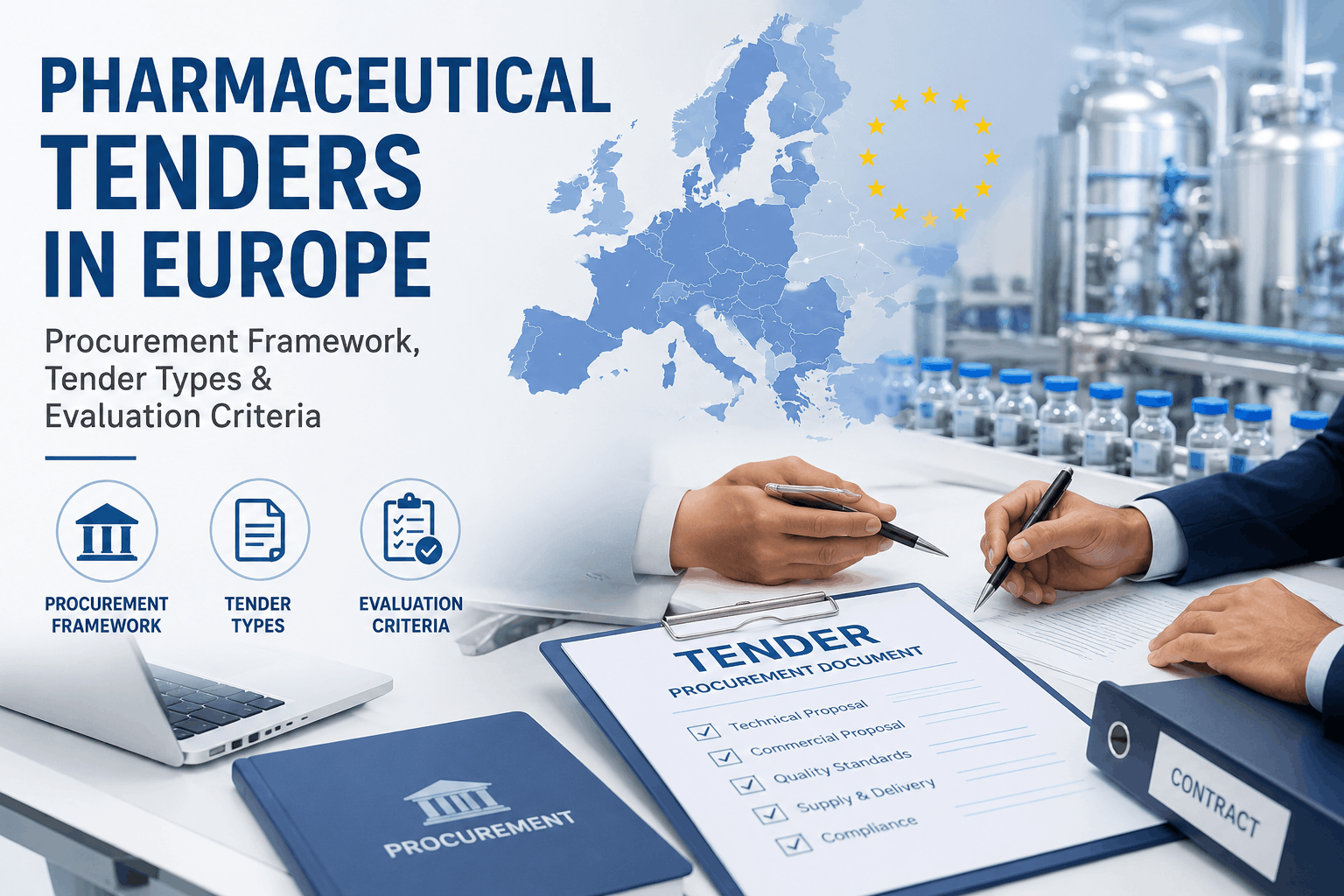
How Government Procurement Shapes Pharmaceutical Access in Europe
Across most of Europe, the way medicines reach hospitals and public healthcare systems is not driven by open-market sales or direct promotion in the way it is in many other regions. Instead, it is built around structured, government-led purchasing, commonly known as pharmaceutical tenders in Europe. These tender systems play a critical role in determining which medicines are procured, supplied, and reimbursed across public healthcare networks.
Healthcare authorities plan their medicine requirements in advance and invite suppliers to compete through formal procurement processes, rather than buying on demand. For any pharmaceutical company looking to operate in Europe, this single fact changes the entire approach to market entry.
Success is no longer just about having a product available. It is about being able to:
- align with procurement expectations, understanding how public buyers define quality, pricing, and supply conditions
- operate within fixed contracts, where flexibility is limited once an agreement is signed
- sustain long-term delivery commitments, which often matter more than the initial price quoted
Because of this, tenders are not simply a procurement formality — in many European countries, they are the primary gateway to market participation.
What a Pharmaceutical Tender Really Involves
At a basic level, a tender is an invitation to bid. In pharmaceuticals, however, it carries far more weight than a typical commercial transaction.
A tender is essentially a structured agreement framework, where a buyer defines not only what they want to purchase, but also how that supply must be maintained over time. This includes detailed expectations around:
- the exact medicine required, including dosage, formulation, and packaging specifications
- projected quantities, often based on historical demand but subject to change
- delivery timelines, ensuring medicines remain available without interruption
- compliance requirements covering regulatory approvals, manufacturing standards, and documentation
- contractual obligations outlining penalties, responsibilities, and performance expectations
What sets this apart from open-market sales is the combination of predictability with responsibility. Once a tender is awarded, the supplier is expected to deliver consistently — not occasionally.
Why This Changes the Way Companies Operate
For companies entering this space, the biggest adjustment is usually not understanding the tender itself, but understanding what happens after winning one.
- Supply becomes continuous, not transactional. Instead of responding to orders as they arrive, suppliers must ensure availability throughout the entire contract period.
- Pricing becomes fixed for the contract duration. Companies must think beyond immediate margins and plan for long-term sustainability.
- Performance is monitored closely. Authorities track delivery consistency, and any disruption can affect future opportunities.
This is why experienced players approach tenders with a mindset closer to operations planning than to traditional sales execution.
The European Procurement Framework: Structured Yet Decentralized
One of the more nuanced aspects of the European system is how it balances uniformity with flexibility.
At a high level, procurement across the EU follows a shared set of principles designed to ensure fairness and transparency. However, the way these principles are applied differs from country to country — creating a system that is consistent in intent, but varied in execution.
What Remains Consistent Across the EU
Across member states, procurement systems are generally designed to:
- Ensure transparency in the process — tenders are published publicly, allowing suppliers to access opportunities without hidden barriers
- Promote fair competition — multiple suppliers are encouraged to participate, reducing dependency on a single source
- Allow cross-border participation — companies from different EU countries can bid, creating a broader competitive landscape
Each of these elements helps create a system that is structured and accountable at its core.
Where Differences Begin to Appear
Despite this shared foundation, the actual process can look very different depending on the country:
- Tender publication methods may vary — some countries rely on centralized platforms, while others use regional systems
- Submission formats and timelines differ — documentation requirements are not always standardized across markets
- Evaluation criteria may shift in importance — in some cases pricing dominates, while in others supply reliability or added value plays a stronger role
Because of this, companies cannot rely on a single approach across Europe. They need to adapt their strategy to the specific market they are targeting — and this is exactly where experienced networks such as Ikris Pharma Network add value, by understanding how these differences play out in real procurement scenarios across Europe.
Types of Pharmaceutical Tenders in Europe
Not all tenders are structured the same way, and understanding these variations is essential for both participation and long-term planning.
National-Level Tenders
National tenders are typically conducted by central procurement bodies and are designed to cover large portions of a country’s pharmaceutical needs. They are often used to:
- standardize purchasing across healthcare systems, reducing variation in supply
- negotiate better pricing through higher volumes
- ensure consistent availability of essential medicines nationwide
Because of their scale, these tenders are highly competitive and demand strong operational readiness.
What makes national tenders distinct:
- Large volumes create both opportunity and pressure. The contract size is attractive, but it requires the ability to deliver consistently at scale.
- Pricing competition is intense. Suppliers often compete aggressively, which can affect margins if not carefully planned.
- Long-term commitment is required. Contracts may run for extended periods, making operational stability critical.
Regional and Hospital-Level Tenders
In contrast to national systems, many countries allow procurement at regional or hospital levels. These tenders tend to be more flexible and closer to actual clinical demand. They are typically:
- smaller in scale, making them more accessible for new entrants
- more frequent, allowing companies to participate multiple times
- slightly less rigid, depending on local procurement policies
Why they matter strategically:
- They provide a practical entry point into the market
- They help build relationships with healthcare institutions
- They allow companies to test operational capabilities on a smaller scale
Over time, success at this level can support participation in larger national tenders.
Framework Agreements
Framework agreements introduce a different model altogether. Instead of selecting a single supplier, authorities create a pool of approved suppliers who can provide medicines under pre-agreed conditions.
How this works in practice:
- Suppliers are pre-qualified, rather than immediately awarded full contracts
- Pricing and supply terms are fixed, but orders are placed as needed
- Buyers retain flexibility to choose between approved suppliers
What this means for suppliers:
- Being selected does not guarantee volume
- Performance still influences actual order allocation
- It creates an opportunity for ongoing participation rather than a one-time win
This model is often used to reduce risk for the buyer while maintaining supply continuity.
What Authorities Actually Look For During Evaluation
There is a common perception that tenders are decided purely on price. While pricing is important, it is only one part of a much broader evaluation. Authorities are responsible for ensuring that medicines reach patients without disruption, and this shapes how they assess every supplier.
Product Quality and Compliance
Authorities first ensure that the product meets all required standards, including:
- regulatory approvals
- manufacturing compliance
- accurate and complete documentation
If these conditions are not met, pricing becomes irrelevant.
Supply Reliability
Beyond compliance, the ability to deliver consistently becomes a major factor. Authorities assess whether:
- the supplier can handle the required volumes
- there is a risk of supply interruption
- contingency plans are in place
This is especially important for critical therapies, where shortages can directly impact patient care.
Logistics and Delivery Capability
Even if a product is compliant and available, it must reach the right place at the right time. This involves:
- efficient distribution systems
- reliable delivery timelines
- proper handling, especially for sensitive medicines
Financial and Operational Stability
Authorities also assess whether a supplier can sustain the contract over time, looking at:
- financial strength
- operational capacity
- past performance, where available
Understanding the Framework Before Entering It
Pharmaceutical tenders in Europe are not difficult because they are complicated — they are demanding because they are structured and precise. Every stage is clearly defined: how tenders are published, how suppliers are evaluated, and how contracts are enforced. But within that structure, there is very little room for inconsistency.
Companies that succeed in this space are not necessarily the ones offering the lowest price or entering the highest number of tenders. They are the ones that understand the framework itself — the tender types, the evaluation priorities, and the EU-wide principles that sit underneath every national variation.
Building that understanding is the first real step toward operating successfully in Europe’s pharmaceutical procurement market — and partners with on-the-ground experience, such as Ikris Pharma Network, can make that first step considerably more manageable.